Thursday, March 12, 2015

FOR YOUR EYES ONLY - ARE CARROTS GOOD FOR YOUR EYES?

You may remember a blog I wrote a while back which answered this age old questions.
Well, Dr. Eyenstein and I decided to tackle it in vlog form as well. Enjoy!


Tuesday, February 11, 2014

For Your Eyes Only

After much deliberating and significant dilly dallying, I've decided to make a transition into video blogs... I hear the cool kids call them vlogs.

For Your Eyes Only is going to be a series of vlogs discussing basically anything and everything related to eyes, much like this blog has been.

Here's a little preview of what to expect... ENJOY!


Wednesday, January 22, 2014

The Path of Least Resistance

Over the past few weeks I've had some distressing discussions and experiences at my new office, Highstreet Eyecare, in Abbotsford BC (shameless self promotion). These incidents are what compelled me back to my blog today.

I'll refer to one specific phone conversation which, I think, fairly represents the other similar situations as well.

A very pleasant young lady (in her mid-20's) called the office with some questions about her vision. I'll briefly summarize the conversation...
--
Young lady: I've noticed some changes in my vision. I can't see as well with my glasses on anymore. I recently went back to the place where I usually buy my glasses. They did an eye exam and said they couldn't get my vision to 20/20.

Me: Do you know if  it was an optometrist who did the exam?

YL: I'm not sure. What's the difference between an optometrist and the people I get my glasses from?

Me: (I proceeded to explain the differences between optometrists, ophthalmologists, and opticians. I explained how they are all different from the many random optical stores that have no accreditation what so ever. I also compared a complete eye exam, which includes a thorough assessment of ocular health as well as a refraction for a glasses prescription, and vision testing, which is essentially the automated refraction many unaccredited places will conduct unlawfully refer to as an eye exam.)

YL: Oh, I didn't know any of that. They just checked my vision and said the new glasses would make my vision better.

Me: (I explained again all the different things we would examine to determine her prescription and rule out any underlying conditions that could be limiting her vision)

YL: Ok. I'll see...
--

You'll see??? If I'm not mistaken, isn't that exactly what you're having trouble with right now... Seeing?!
Ok, I didn't say that. I can be a little sarcastic and condescending sometimes, but I'm not mean. Especially not to my patients.

These types of conversations bring to light many different concerns. A few of which I will try to address here.

But first, lets time a quick step back... way back... back into time... (Blackstreet reference... anyone?)

A few years ago, when I had first started practicing optometry, I wrote multiple blogs about the impending changes that my profession was about to endure. Changes that were brought on by crony politicians, whose only concern was to fill their pockets with little regard for the public, whom they were elected to serve (I'll try not to name any names... but, lets just say it was a certain "Health Minister"... who's name may or may not start with Kevin... and end with Falcon...). These were changes which ultimately contributed to the lowering of health care standards in British Columbia. And they were changes which led to the fall of a childhood hero from his perch upon a pedestal... I'll never look at Trevor Linden the same way again. But, I digress...

Today, ONLY in British Columbia, a person can walk into any store operated by any individual with absolutely zero credentials and no experience in eye care to buy glasses or contact lenses without a valid prescription. I think that makes it hard to disagree that our standards of health care, at least eye care, are lower than those of any other place in North America.

The Health Minister defended himself by saying that the average individual who has healthy eyes should not have to bother with regular exams and those who do have eye conditions will simply know to have their eyes checked regularly. So much for preventative care. I wonder if Mr. Falcon would be so kind as to describe the symptoms of the early stages of glaucoma, a disease which is one of the leading causes of blindness and affects tens of millions of people worldwide... Oh that's right, there aren't any! It is a silent disease. By the time a patient notices the symptoms, there has already been irreparable, irreversible damage. But I'm sure the average person would somehow know, right?

There is also supposed to be a regulation which, loosely translated, states that if an optical store cannot improve a person's vision to 20/20 or sees any reason for concern, they must send that patient over to an optometrist or ophthalmologist for further testing. Clearly, in the case of the young lady in the above conversation (and many others), they have not been doing that. Which means there are a lot of people walking around with a lower quality vision than they deserve AND, more importantly, potentially suffering from a vision threatening condition.

So, what needs to be done?

I've spent a lot of time pointing fingers at different people for tearing down the foundations of our health care. And there definitely are a lot people who are responsible for the failure of our system. Yes, the big companies and the crony politicians play their part. And they play it well. But, it is important to understand that WE must also bear some responsibility. By we, I mean both health care providers AND the public. It is absolutely my responsibility as a health professional to educate my patients and the public about their health. If I don't do it, then who else will? But, it is also the responsibility of the individual to actively seek out what is best for them. To ask questions, get regular exams, and do what ever else necessary to keep yourself healthy. If you don't, who else will?

Too often, I hear patients say "I've had issues for a long time, but I kept putting it off". As terrible as it sounds, I can understand, I can relate. We build routines for ourselves and follow them, often blindly (pardon the pun). Call it complacency, laziness, or anything else... We put important things off because it means going out of our way or changing our schedule.

Our bodies are made up, at the most basic level, of cells and nerves and chemical reactions. All of which are following the path of least resistance. So it is only human nature that we do what is easiest for us, to follow the simple route. But on our highest level, we are able to make the decisions about what's best for us. And I urge you, when it comes to your health, whether its your eyes or your teeth or your heart, take the time to get it done. And get it done right.


Thanks for reading. Please feel free to leave comments or questions. I'm always happy to discuss!


Monday, March 4, 2013

Contact Lens Addicts Anonymous

Its been a while since I've written a blog post. So long, in fact, that blogger.com emailed to tell me that my site had developed virtual cobwebs... kidding!

Well, I'm back. And its all thanks to a crazy day at the office. This past Sunday (yes, I work Sundays... and yes, I am a little bit crazy... thank you for asking), I felt like I was working in some sort of contact lens emergency clinic. It was like Clearly Contacts was having a sale on eye infections or something! I'm sure the Liberal government backed them on it and I must have missed Trevor's ads on TV...

Moving on...

A while back, I wrote a blog titled Contact Lens Addicts, which explained how some patients become so dependent on their contact lenses that they put themselves at risk of suffering many different problems, some of which could lead to permanent vision loss. Well, Sunday was like a Contact Lens Addicts Anonymous meeting at Metropolis Eye Care.

The CL-AA meeting started with a pleasant, 50-something woman whose contact lens had folded up and tucked itself so far behind her upper eyelid that I almost wished I had a third hand to help flip her eyelid, and/or hold a q-tip, and/or grab the forceps.

Now, lets just take a quick second to answer the question that is likely swirling around in some of your minds... No, the contact lens cannot go so far back that it ends up behind the eyeball. Luckily, the conjunctiva (the thin skin that covers the eye ball) actually folds over itself and covers the inside of the eyelids as well. Effectively creating a natural contact lens catching contraption (and you thought conjunctiva was hard to say).


Next up was a very friendly lady in her mid-thirties who is actually quite good at taking care of her contact lenses. She doesn't over wear them, she replaces them on schedule, and she's good at cleaning them every night (sounds too good to be true, but I believed her). However, despite all of the regular care and maintenance, she managed to fall asleep in her lenses.

Now, we all know that one night stands are a bad idea (right?). Well, sleeping with your contacts is a lot like a one night stand...  There's usually booze involved, it seems like a good idea at the time, you wake up in the morning with something feeling itchy and/or irritated (we're talking about eyes folks!), and then you're doing the walk of shame... into my exam room!

Even for someone who takes care of her contacts, one night with her lenses was enough to cause a small corneal ulcer, secondary to a bacterial infection. Yes, an ulcer. Yes, its as unpleasant as it sounds.


Last, and certainly not least, is the poor little girl who forced me out of blog-writing retirement to tell you her unfortunate story. A 16 year old kid who has been wearing Ortho-K lenses. I won't go into detail, but basically these are lenses you only wear at night while sleeping. Hopefully the "only wear at night while sleeping" part raised a red flag or two for most of you. To make matters worse, she was fit for and bought the lenses overseas, so I have no idea what she's been wearing. Not all that different than buying contacts online without being fit for them by a professional, might I add. But I digress...

The poor kid was in so much pain, she could not open her eye if her life depended on it. When I finally got a look, this is what I saw...
A very red and upset eye with a large, central corneal ulcer. Long story-short, she is and will be in need of a lot of eye drops (as much as every 30-60 minutes all day AND night) and maybe even some oral medications. The worst part of it is that when the infection is finally controlled, this ulcer will likely leave a large scar right in the center of her vision thus causing a permanent decrease in vision in that eye.

These were just three of the multiple cases I dealt with during the CL-AA meeting on Sunday.

Its extremely important to understand the consequences of taking our vision for granted. Online sales and deregulation have made it easy to overlook the fact that contact lenses are actually medical devices. They are pieces of plastic that we put on our eye ball to help improve our vision. We should not lose sight of that (pun intended).

I am genuinely concerned and upset about this young girl and so many other patients who suffer from serious issues due to improper contact lens wear and poor ocular hygiene. So, if you or your kids wear contacts, be sure to have the lenses fit by a professional and never hesitate to come in and have your eyes checked if you think something is wrong. As with most things, if we catch it early, its much easier to treat.

Please feel free to comment here and message me via Facebook or email if you have any questions or comments.


Note: The pictures are not of my patients, but are accurate representations of their respective issues.

Monday, January 9, 2012

The Eye-Heart Connection

Happy New Year! I hope everyone enjoyed their new year's eve celebrations. And hopefully there weren't too many cork-to-eye incidents.

You may have heard the saying "The eyes are windows to the soul". I've looked into a lot of eyes but I'm not sure how many souls I've seen. So I thought we could re-phrase that statement a little. How does "The eyes are windows to your overall systemic health" sound? I guess thats not as magical, but its proably a little more accurate.

A couple of weeks ago, a friend sent me this picture and asked "do you know about this?"


Well, yes Harvinder, of course I do! But, thanks for asking :)

I spend a lot of time on a daily basis explaining to patients how the eyes can present signs for all sorts of systemic health issues especially those related to blood vessels. The one I stress the most is diabetes because it is seen most commonly and can have profound visual consequences. However, high blood pressure, high cholesterol, anemia, and more can all be detected by changes in the blood vessels inside the eye.


In patients who have cholesterol build up in larger arteries, it is possible for small pieces of plaque to break off and travel through the blood stream into the eye (these are called emboli). The emboli can get stuck in the small blood vessels and cause a blockage.


The particular signs mentioned in the article above are called xanthelasma. These are elevated patches around the eyelids due to fatty deposits under the skin. These are usually considered to be benign but as the article mentions, recent studies have shown a link to higher rates of heart disease. To read the full New York Times article click here.


Another ocular sign which is related to cholesterol is arcus senilis. This is a very common finding in older patients and is due to cholesterol deposits in the cornea (the clear dome at the front of the eye). Patients with arcus will develop a greyish ring around the outer part of the cornea. While arcus is related to cholesterol, it does not necessarily indicate high cholesterol or heart disease.


If there is ever any concern about systemic health issues affecting vision or eye health, please visit your friendly neighborhood optometrist and they will be happy to do a detailed examination :)

And as always, regular eye exams are recommended for all!

Thursday, December 15, 2011

Wheat is The Enemy!

Wheat a minute... I mean, wait a minute! Wheat is what? I thought that whole wheat was the almighty, the healthy choice, the answer to all our dietary fiber needs. Well according to Dr. William Davis in his book "Wheat Belly", wheat is the exact opposite. Apparently, due countless genetic modifications which have made wheat ubiquitous in modern western society, the popular grain can be linked to an innumerable variety of diseases including, but not limited to, obesity, diabetes, colitis, celiac disease, heart disease, dementia, schizophrenia, ADHD, and even hair loss!


Now I'm not going to sit here and say that I believe every word that Dr. Davis has to say about  my beloved breads, buns, and bagels, but he did make some impressive arguments on many different levels. However, at the end of the day, this blog is about eyes. And there are some undeniable truths in the book that relate to our vision.

The main topic I want to touch on is the conversation Dr. Davis has about wheat's ability to raise blood sugar and, in turn, cause diabetes. I take diabetes very very seriously. I've seen many patients suffer visual and other physical consequences due to diabetes. Well, apparently wheat (even the whole grain variety) has a remarkable ability to significantly affect blood sugar. Even more than plain table sugar! That's a little shocking to someone who eats two slices of toast at breakfast and two more slices in a sandwich at lunch!

I have written a blog in the past about all the different ways diabetes can affect vision. Here's the short version: cataracts, retinal bleeding and swelling, glaucoma, and detached retinas. These are all possible at varying degrees and can potentially lead to permanent blindness. And all thanks to poorly controlled blood sugar.

Healthy Retina

Severe Diabetic Retinopathy
I have to admit, I was impressed by some points that were made in the book. So I decided to give the no wheat deal a try for a little while, much to chagrin of some people close to me. Its been a couple of weeks and, other than a few early difficulties, its going surprisingly well. I'll let you know how it goes...


Monday, October 31, 2011

Amare Stoudemire's Goggles

I'm sure most Vancouver hockey fans still remember quite vividly the injury that Manny Malhotra sustained last season. At that time, I wrote a blog about the possbile consequences of traumatic injuries to the eyes. Corneal abrasions, glaucoma, retinal detachments, cataracts... these are all serious and real possibilities.

While Manny's injury was serious and required multiple surgeries, he was (and we were) very fortunate that he was able to recover vision and return to play.

But its not only hockey players that need to be aware of these types of injuries. Even in sports like basketball, players need to be cautious. And, as Amare Stoudemire will tell you, its not just the ball you need to watch out for

During the pre-season in October 2008, Stoudemire was accidentally poked in the right eye by his teammate Boris Diaw. He temporarily lost vision in that eye and suffered a torn iris. This is something I did not mention in my blog about Manny, but let me tell you now, this is very painful!


After this major scare, Amare swore that he would wear protective eyewear for the rest of his career. He did for a little while, but found the goggles to be annoying so he stopped after a few games.

Call it karma, call it bad luck, I just call it unfortunate... But a few months later, in February 2009, Amare was hit in the same eye again. This time he suffered a detached retina and required surgery. He was out for 8 weeks which meant he had to miss the remainder of the regular season. When he returned, Amare made sure to keep the goggles on.

Here's a video of Amare discussing his injury and the importance of eye health and protective eye wear.

http://www.youtube.com/watch?v=qA-SemX-mzU

Protect your eyes!

Special thanks to Dr. J. Armani.

Monday, October 17, 2011

Like Pulling Teeth

This past weekend I had the wonderful pleasure of attending the American Academy of Optometry's annual conference in Boston. I had the chance to reconnect with a lot of classmates and friends, as well as visit my school and attend lectures at the meeting. One evening, as we were enjoying a night out on the town, a current 4th year student approached me and said "Harbir, you need write a blog about the importance of regular eye exams!". I told him that I'm sure I've mentioned it a few times already. "Yeah, but why is it that people are willing to go the dentist to get their teeth cleaned every 6 months but they refuse to have their eye health checked every 2 years?!" (Yes, he was both inquisitive and exclamatory all at the same time).

This particular discussion has been a long time coming. I talk about it daily with patients, friends, family, and random unsuspecting people walking down the street who I unwittingly coerce into coversation. But, to this day, I have avoided writing about it because I was afraid that I would end up writing a novel, or it would open up a can of worms, or that all the dentists in the world would hate me and I would never be able to recieve adequate oral care (I guess its a good thing I've never had a cavity!). But, with this recent encouragement from the enthusiastic intern, I decided to give it a shot. And I will try to keep it short!

Less 24 hours after being newly inspired, I had the most convient and fortuitous encounter with friend of a friend who just happened to be a dental student. True story. After restraining myself to allow an appropriate amount of time to become acquainted (maybe 30 or 40 seconds), I jumped at the chance to talk about having my teeth examined bi-annually.

Allow me to summarize.

Harbir: Why do dentists have patients come back every 6 months to have their teeth checked?
Dental student: Because we can.

Ok fine, thats not exactly what she said. But, the gist of the story was, dentists have convinced the world that having your teeth scraped with sharp tools and gargling fluoride every six months are absolutely necessary. When, in fact, according to my new acquaintance who now probably hates me, there is no direct correlation between oral hygeine and dental health. Having your teeth cleaned is not the important part. The few minutes at the end of the visit where the dentist pokes and prods around with another sharp instrument, thats the important part. But even that doesn't need to happen every 6 months. Nonetheless, oral care professionals have done an amazing job of convincing people that these regular visits are obligatory.

I'm not mad at them. In fact, I applaud them. I reach out to them and ask them how I can convince my patients to have their eye health examined more frequently.

I know this is a bit crude but honestly, what happens when your teeth fall out? You get new ones. Crowns, or veneers, or dentures. In any case, you can smile and bite and eat again. But what happens when you lose your vision? Nothing. Once its gone, its gone.

But we don't clean or polish. We refract and dilate. Maybe thats not as exciting for patients. Maybe we should start a new division of eye care where we have people come in to have their eye lids cleansed and eye drops instilled every six months. We'll call it ocular hygeine. Maybe then I'll have patients in my chair more regularly so I can check for silent eye diseases like glaucoma that can cause irreversible vision loss in asymptomatic patients. Because convincing people of the latter alone does not seem to be enough.


Note: This blog was not inteded to question the importance of the dental profession. It was just a reference to help outline the importance of regular eye exams.

Wednesday, September 14, 2011

Why Do We Blink?

In my first year of optometry school, as part of the practical portion of our studies, we used to do vision screenings on kids in elementary schools around Boston. So picture me, the tall optometric freshman, kneeling down to examine the eyes of this adorable little 6 year old girl when she steps back and asks out loud "Harbir, why do we blink?". The whole classroom stopped and looked up at me...

I paused for a second, gathered as much information as I could from my 3 months of eye-related education, and began to answer. Well, cute little blonde-haired girl whose name I don't remember, there are 3 main reasons for blinking:

Number 1 is protection. Our eyelids and eyelashes provide a protective barrier against foreign objects such as dust, rocks, bits of metal, fruit flies, etc...

The second reason is lubrication. Every time we blink, our eyelids squeeze out small amounts of oil, water, and mucus to line the surface of the eye. Studies have shown that when we are engaged in activities that require more attention, we tend to blink less. That is why spending a lot of time on the computer can lead to dry eyes. So as soon as you're done reading this blog, get off the computer! Then come back and share it with all your friends :)

And last, but not least, the third reason for blinking is irrigation or removal of tears and waste. Our eyelids act similar to squeegees, the wonderful onomatopoeically named tool that helps smoothly remove water from car windows and such. Each time we blink, the lids pull tight and sweep tears and debris off the surface of the eye and towards the drainage duct which is located at the inner corner of the eye.

And that's why we blink.

Thursday, September 1, 2011

The Importance of Early Eye Exams for Kids

Since its back to school season, I thought it would be a good idea to write a little bit about childrens vision. I've been seeing a lot of kids in the past couple of weeks, most of whom are bright, young, happy, and healthy. Its actually kind of a fun experience for me. I get to hear a lot of interesting stories about their summertime activities. I find myself living vicariously through my young friends since I've spent most of my summer locked up in my dark exam room!
While most of the kids I see are returning for their annual check up, some are coming in to experience the fun and excitement of a Dr. Sian eye exam for the first time. Parents who are bringing their kids in for the first time will often ask me "When should my child have his/her first eye exam?". The answer is usually a bit surprising.

The American Optometric Association (AOA) and the Canadian Association of Optometrists (CAO) both agree that a child's first eye exam should be at 6 months of age. Of course, we don't expect the little munchkins to be able to read letters or even complain about blurry vision. But, it is vital at this age to make sure that the major structures of the eye are developing normally. One significant concern at this age is retinoblastoma, which is a tumor of the retina, the back surface of the eye. If caught early enough, it is possible to prevent the spread of the cancer to other parts of the body and, hopefully, save the affected eye.

A few years back there was a remarkable story of a person who detected a tumor in a baby's eye just by viewing photgraph and noticing that one of the pupils seemed to have a white reflection. This simple sign probably saved the baby's life.
Here's the story:

Interestingly enough, one of the tests we do on children, called the Bruckner test, actually mimics this same reflex seen with camera flashes. Simply by watching how light reflects off of the the retina, we can determine the general health of the eye, the shape of the eye (astigmatism), and a potential prescription for glasses (if necessary)


After 6 months, it is recommended that children have annual check ups to make sure everything is developing well.

In Canada, our health care system is based on prevention. In BC, Kids eye exams are free up to the age of 18. Regular check ups mean earlier detection and easier treatment.

Check Yearly, See Clearly!

If you have any questions or concerns, please don't hesitate to write to me or visit your friendly local optometrist :)

Also, take a peak at the following websites, they are very informative.

BCAO:
http://www.optometrists.bc.ca/code/navigate.aspx?Id=3
CAO:
http://www.opto.ca/en/parents/parents-corner.html
AOA:

Wednesday, August 17, 2011

Buying Cheap Shades and Reading Glasses Can be a Headache. Literally.

Its always nice to write a blog that is related to conversations I have with patients in the clinic. This is a topic I discuss with patients almost every single day and I've been meaning to write about for a while. I finally got around to it thanks to a little kick in the butt which came in the form of a little story on the radio.

Recent research done by the consumer group "Which?" in the UK showed some interesting results when I came to assessing the quality of drug store/dollar store/grocery store sunglasses and reading glasses.

The most recent investigation was regarding sunglasses bought at these types of stores. Some lenses in these sunglasses didn't allow consistent amounts of light through, which can make depth perception difficult. Other lenses induced prism, which means that each eye receives two slightly separated images. This can lead to headaches and double vision. And finally, some of the glasses actually induced astigmatism, which can result in blurry vision, discomfort, and headaches.


All suglasses, expensive or cheap, do provide some amount of UV protection. Considering the fact that some of the more serious eye diseases (such as cataracts and macular degeneration) come as a result of UV exposure, I would prefer that my patients wear something cheap rather than nothing at all. However, if you do experience any discomfort, it's probably better to look into a better quality product.


A few years earlier, "Which?" looked into over-the-counter reading glasses or "cheater readers". These are glasses that many people will pick up when they start to notice problems with seeing clearly at near. This is a condition called presbyopia and it affects almost everyone over the age of 45.


While these glasses may "do the trick" for a lot of people, they can induce problems similar to those noted in the sunglasses convo. Firstly, a lot of people have some amount of uncorrected astigmatism. Also, it common for people to have slightly different prescriptions in each eye. OTC readers do not account for either of these things, which leaves patients with slightly blurry vision and forces the eyes to work harder in an effort to overcome the prescription. Secondly, it is important to remember that these glasses are a "one size fits all" variety. Beacause of this, the center points of the lenses (where the vision is most clear) often do not line up with the center of the patients pupils. This can leave patients with discomfort, fatigue, and double vision after prolonged periods of wear.

The best thing to do is have your glasses prescription and eye health checked by your friendly optometrist and then look into a quality pair of prescription glasses.

http://www.which.co.uk/news/2011/08/high-street-sunglasses-fail-british-standards--------262336/


Thanks to Jasmina at The Beat 94.5 for passing on the info.

Thursday, August 11, 2011

Eye Bling

I knew this day would come. In fact, now that I think about it, I'm a little surprised it took this long.

Dr. Chandrashekhar Chawan, based in Mumbai, has designed gold-plated, diamond encrusted contact lenses.


Dr. Chawan has taken a scleral contact lens (a large lens that extends out to the whites of the eyes), which is normally used for treating patients with complicated corneal diseases, and given it enough bling to make even the Cash Money Millionaires happy! (for those people who are unfamiliar, that is the group that made the popular rap song titled "Bling, bling" back in 1999)
Lil Wayne from Cash Money
If you are tolerant enough to get passed the discomfort of a 20-25mm diameter hard scleral lens, then all you have to pay is $15,000 for one pair. No, that is not a typo. That's 15 comma 3 zeros. But, the way the wedding industry is booming these days, I guess it won't be long until we see some lovely bride walking down the isle looking like someone out of the Twilight movies.
Btw, I'm on Team Jacob
The company is called La SER Eye Jewellery. Check out their site for more info, lasereyejewellery.com.

Wednesday, July 13, 2011

Contact Lens Addicts

Yesterday I had the not so pleasant experience of having to scare one of my patients out of wearing contact lenses. It inspired me to write a little about contact lenses and those who (over)wear them.


It has occurred to me, over the past year or so, that some patients are addicted to wearing contact lenses. These people are like the crack addicts of the ophthalmic world. They need contacts. They'll do anything to get contacts. They will come in begging for samples. And when you suggest to them that they should quit, they freak out!

For these people, going straight and cleaning up their act means having to wear glasses. And just like any other addiction, its hard for people to quit cold turkey. They come up with all sorts of excuses like "I don't like my frames", "I lost my glasses", "Glasses make my face look fat". Well I got news for you, Chubs... Its not the glasses!

Anyway, this is where I come in. I'm like the motivational speaker on those self help tapes that tell people that they are strong and in control of their lives. "Where there's a will, there's a way" and all that good stuff. Oh and also, if they don't quit, they could go blind.

That last note usually helps me get people's attention. And it worked yesterday with my 19 year old patient who had been wearing coloured contacts (not the best quality lenses) 7 days a week for the last 5 years. She does not own a pair of glasses and therefore has been wearing her contacts from morning until night.

Why is this so bad?

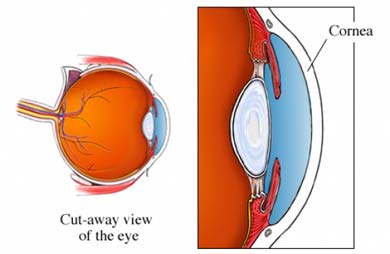
The cornea, which is the clear dome at the front of our eyes, has a very high demand for oxygen. The only place the cornea can get oxygen is from the air around us. As you can imagine, covering the cornea with a piece of plastic will significantly reduce the amount of oxygen that gets through. The cells of the cornea starve for oxygen and start to break down causing the cornea to become less clear thus making vision blurry.

Neovascularization of the cornea from the 3 to 6 o'clock postion

The body's response to this lack of oxygen involves creating new blood vessels into the cornea. This is called neovascularization. While this may seem like a good idea, it is actually the exact opposite. If the blood vessels grow too far into the cornea, they can begin to obstruct/distort vision. There is no way to reverse neovascularization of the cornea. It can be stopped or slowed down by decreasing contact lens wear. But if it is very significant, the only treatment is corneal transplant surgery. And believe me when I tell you, you do not want corneal transplant surgery.


Cornea with stitches, post transplant


Its sad to see a person as young as 19 be at risk of permanent vision loss. But, with a little treatment and staying out of contacts for a while, her eye health (and vision) should improve.

As useful and convenient as they are, contacts can cause a multitude of different ocular problems if worn incorrectly. All patients who wear contact lenses should have regular eye exams.

Wednesday, June 22, 2011

Sports Vision Contact Lenses


Contact lenses are essential to any athlete who requires vision correction. Can you imagine pro athletes wearing glasses while playing hockey, or basketball, or football? Contacts provide clear vision while also providing unobstructed peripheral vision.

But that's not all they can provide. A few years back, Nike and Bausch & Lomb collaberated to produce a revolutionary new contact lens called Nike MAXSIGHT. The lens was designed with a tint to enhance sport-specific vision above and beyond what a normal soft contact lens could provide. There were two colours available: amber and grey.


The amber lenses were designed for fast moving ball sports such as tennis, soccer, and baseball. The theory here is that human visual acuity is actually optimized around the yellow wavelengths, so the lens will allow mostly yellow rays through and absorbs the rest.


The grey lenses were more for sports or activities generally conducted in bright environments but did not require tracking of fast moving objects such as running or golf. The lens decreased glare thus making vision more comforable.

TSN recently did a story on Henry Burris, the quarterback of the Calgary Stampeders (CFL). In the 2008 season, Burris was wearing the amber tinted lenses. Calgary went on to win the Grey Cup that year. Burris decided to go back to the lenses this season, hoping for similar results.

In the first pre-season game of the 2011 season, The Stamps were shut out by the BC Lions, 24-0. Maybe Burris wasn't wearing the lenses that day ;)

Here's the video of the interview on TSN. You can clearly see the redish tint around his iris that is coming from the amber tinted lenses. http://watch.tsn.ca/cfl-news-and-highlights/#clip487910


Unfortunately, the MAXSIGHT lenses were discontinued shortly after they were introduced. There are other lens designers that produce a similar lens, but they're harder to find. Ask your eye doctor about sports vision lenses.

Henry Burris mentions in his interview that with the lenses in, lights seemed to be dimmer and he was able to look right into the sun without any problems. I would like to interrupt Mr. Burris here for a moment... Understandably, the tinted lenses may help make vision more comfortable in sunlight, but under no circumstances should anyone be staring directly at the sun!
Please refer to Sunburn in Your Eyes for more information.

Monday, June 13, 2011

Do Cucumbers Cure Dark Circles?

Numerous times in my life, mostly in my teens, I had people approach me and ask me if I had been in a fight or punched in the face for some reason. Most of the time, the answer was no. At first I wondered why people kept asking me this question? I soon realized that, unfortunately for me, I was predisposed to developing "bags" and "dark circles" under my eyes.

I always wondered why. The answer I was given most often was that I wasn't sleeping enough. But, honestly, as a teen I was getting 8-10 hours of sleep every weeknight and probably closer to 14 on weekends (yes, I was a lazy kid). So, then the answer changed to "you're sleeping too much". I would like to take a moment here to thank everyone in the past who supplied me with this invaluable information.

So why do we get dark circles and bags under our eyes??

First, lets talk a little anatomy!
The skin covering our eyelids is very thin. In fact, its the thinnest of any part of the body. This makes the skin more translucent (somewhat see through). Immediately underneath this thin skin is a dense network of small blood vessels which can dilate and become leaky just like all other blood vessels in the body.

Genetics
Unfortunately, this is the most likely answer for the majority of people. Thin skin plus superficial blood vessels equals dark circles. Simple equation. Its usually more pronounced in fair skin individuals but can also be noticeable in dark skin as well.

Allergies
People who suffer from allergies often have puffy eyes. This is because allergies cause blood vessels to dilate and become leaky. Dilation of the vessels adds to the colour and the leaking makes the eyelids swell.

Rubbing Your Eyes
I wrote a blog on this a while back explaining why its bad. In this case, rubbing can cause the little blood vessles to break. This results in darkening and swelling. Also, in allergies, rubbing can release more of the histamines that cause the allergic response in the first place.

Sleep and Stress
Less sleep and more stress. Bad for you in so many ways.

Age
As we age, our skin loses elasticity and slowly begins to sag. This exaggerates the look of bags under the eyes.

What's the Treatment?? 

There are so many creams, ointments, and roller-thingys on the market that claim to reverse the appearance of dark circles. What I have always wondered is, if these creams, ointments, and roller-thingys all worked so well, then why is there a new product coming out every other day??
Applying Cold
What do we do when we sprain an ankle? How about for a bump on the head? One of the first things we reach for anytime there's swelling is an ice pack. The cold helps decrease swelling by decreasing inflammation and reducing blood flow to the affected area. The same simple therapy can be applied to our eyelids.

Cucumbers
As far as I can tell, there's no scientific reason for cucumbers to be the miracle cure. I've read in places that they contain some nutrients that help lighten skin, but as we have already established, the skin is not usually the problem. The only thing I can think of is that cucumbers are cool (in temperature, not social status) and as we discussed, applying something cold can reduce swelling.
Cold Tea Bags
Its possible that the caffeine in tea can help constrict the blood vessels below the skin's surface. And again, the cooling effect would be helpful.

Make-Up
My favourite solution.

Laser Treatment
This is generally reserved for people who have skin pigmentation problems.

I worked with an Oculo-Plastics surgeon for a little while during one of my clinical externships. I asked him if there was anything he could do for dark circles around the eyes. His advice: "Cover your eyes and tan the rest of your face".

If you are ever worried about the skin on or around your eyelids, please see your eye doctor or dermatologist.

Wednesday, May 18, 2011

May is Vision Health Month!

Vision Health Month is an initiative that was started last year by the Canadian National Institute for the Blind (CNIB).

The goal is simple: Increase awareness about ocular disease and prevent vision loss.

Many eye diseases are "silent" and cannot be detected by the patient until there is significant vision loss. Unfortunately, this lost vision often cannot be recovered.

Glaucoma is a disease which usually starts off by affecting peripheral vision. Often times it is not noticed by patients until they start bumping into objects or have difficulty changing lanes when driving.

Macular degeneration is another slow moving disease that normally doesn't show up until our 50s. But it affects the macula, which is what we use for central vision.

Although the effects of these two diseases cannot be reversed, early detection can allow us to significantly slow the progression of the disease and allow patients to continue on with healthy, clear vision.

It is important to remember that just because a lot of diseases occur later in life, doesn't mean that prevention at earlier ages is not necessary.

Cataracts are a perfect example of this. Most people understand that cataracts generally develop with age and usually become significant in patients over 50. However, recent studies have shown that a majority of the damage to our eyes from UV light actually occurs in our youth, before the age of 17!

Three easy ways to help your vision:
Eat your veggies, Wear your sunglasses, and See your eye doctor! :)
---

Your Doctors of Optometry are here to help you with any questions you have regarding your eye health including kids' health, early prevention, surgery, and anything else you can think of!

In BC, kids 18 and under are free and seniors, 65 and over, are partially covered (amount depends on the clinic).

Check Yearly, See Clearly!

CNIB.ca
BCAO.ca

Monday, May 16, 2011

Georges St-Pierre's Eye Injury

If you watched the UFC 129 championship fight on April 30th or saw pictures immediately following, you probably wouldn't have suspected any serious problems with Georges St-Pierre's left eye. Fine, it was a little swollen and maybe there was a little blood but honestly, not much more than you might expect after going 5 rounds in an MMA title fight.

But during the fight GSP was poked in the left eye and, as a result, was left almost blind in that eye for the remainder of the fight. After the fight, the champ was taken straight to the hospital to be examined and it was determined that he had suffered a hyphema, which is essentially bleeding inside the front segment of the eyeball. As we know, blood is not clear, so when it starts to fill up behind the cornea (the clear dome at the front of the eye), you can assume it will begin to cloud vision.
For those who have read my blog before, you may remember I spoke a little about hyphemas recently when Vancouver Canucks center Manny Malhotra suffered a serious, season-ending injury after being hit in the eye by the puck.

Hyphemas generally clear up on their own with a little rest as the body resorbs the blood over time (kind of like a bruise). But in some cases they can lead to permanent vision loss and increase the risk for glaucoma. Basically, the blood can stick to the inside of the cornea and leave it looking "dirty", thus resulting in blurry vision. It is also possible for the blood cells to clog up the draining system inside the eye which results in a back up of fluid thus increasing the pressure inside the eye. This increased pressure is what leads to glaucoma.

Fortunately for GSP, there were no other serious problems such as retinal detachments and after a couple of weeks of rest, his vision has returned and he is back in gym training.

As you can imagine, eye injuries are pretty common in a sport where you're constantly dealing with blunt trauma to your face. From a fighter's perspective, it creates a serious challenge. Whether the eye is swollen shut or filled with blood, the fighter loses depth perception and can no longer judge distances well. That makes throwing punches, blocking punches, and attempting takedowns all very difficult.

Luckily GSP was able to overcome all of those difficulties and successfully defend his title.


Related Posts:
Eye on Manny Malhotra
Why Josh Koscheck Lost: An Eye Doctor's Perspective
Mirko Cro Cop Suffers Serious Eye Injury

Thursday, April 21, 2011

Eye Love Serendipity

I'm sure most of us would agree that some of the best things in life happen by accident. Indeed, some of the greatest scientific discoveries were the fruits of good fortune. Penicillin, vulcanized rubber, and even gravity were all accidental findings.
But these discoveries all pale in comparison to pharma company, Allergan's newest serendipitous breakthrough! (yes, I'm being mildly sarcastic)

In 2001, Allergan produced an eye drop named Lumigan (bimatoprost ophthalmic solution 0.03%). It's primary function was to decrease the pressure inside the eye in patients who had, or were at risk for, Glaucoma. Lumigan was very successful, but it had some interesting side effects.

Doctors noticed that patients were returning to clinics with very specific complaints. Their eyelashes were, all of a sudden, growing at exponential rates. So significant was the growth of these cilia, in fact, that eye doctors were actually having to trim some patients' lashes!

It didn't take long for someone at Allergan (I'm sure it was a woman) to realize how huge this could be. A few years of "research" later, plus a lovely new spokeswoman (Brooke Shields) and voila! In 2008, we have a product named Latisse, which just happens to be bimatoprost ophthalmic solution 0.03%. (How did that take 7 years??)


Anyway, Latisse promises (and, for the most part, delivers) longer, thicker eyelashes. You simply dab a little bit along the upper eyelash margin once a day for 16 weeks (that's 112 days to be exact) and before you know it you'll be a modern day Elizabeth Taylor (more on her later).

Check out the Latisse website (www.latisse.com) for their FAQ section which has answers to questions including side effects, application, and where to find this miracle drug.

Here is one of the more important question and answers from the website:
Question: Does Claire Danes really use LATISSE®?
Answer: Yes. Claire Danes is using LATISSE® and is happy with her results.

Well I'll be damned!! Sign me up then! 

---

Monday, April 18, 2011

Sunburn in Your Eyes?

Many people, especially those of us who are pigmenatally-challenged (not to be mistaken with people who are pigmentally-confused... urbandictionary.com), have suffered from the occasional sunburn. You get it on your shoulders, your back, even your face. But what about on or inside your eye? Yes, it can happen.

Photokeratitis, aka Solar keratitis, is basically sunburn of the cornea (the clear dome at the front of the eye). It happens when the eye is exposed to high amounts of UV light even if only for a short period of time. This can occur from natural sources (ie. the sun) or, more commonly, from artificial light (welder's arc).

The consequences are similar to those of corneal abrasions. Pain, redness, blurred vision, and potential scarring of the cornea which can lead to permanently decreased vision. Just like regular sunburns, you don't notice the pain until a few hours after the excessive exposure.

Solar maculopathy is the same problem but in the back of the eye, on the retina. The macula is the small central point on the retina where all of the light that enters the eye is focused. Maculopathy usually occurs when a person looks directly at a very bright light or UV source for an extended period of time.
The problem most commonly occurs when people stare at the sun. There are quite a few people (more than you might expect) who believe that sungazing provides spiritual and wellness benefits. There is no scientific evidence to support this.

The consequences of solar maculopathy can be severe. In the worst cases, there can be permanent loss of central vision. In other cases, the loss of vision is temporary and is recovered over time.

All of the enery and heat from the sun is focused by the eye to one tiny point on the retina. Its the same idea as using a magnifying glass to kill ants.

A few years ago, there was a story in the news about people in India who were looking for an image of the Virgin Mary during a solar eclipse. Not surprisingly, a lot of them developed serious problems with their vision! Read this story here.

Take home message: Wear your sunglasses, wear your welding mask, and DON'T STARE AT THE SUN!!

Recent Popular Posts:
Eye On Manny Malhotra
Snoop Doc and Dr. Dre, OD
How Trevor Linden Sold Out: The Prequel

Monday, April 4, 2011

Another Hockey Eye Injury... Vincent Lecavalier

Somebody out there really wants us to take note of how easy it is for hockey players to sustain serious injuries in and around the eye.

Two weeks ago...
I wrote about Manny Malhotra's injured left eye and the many potential complications that can arise from taking a puck to the eye. The blog managed to gain a bit of attention and I was very fortunate last week to have the opportunity to speak on both the CTV evening news and RJ1200 morning show about Manny's injury and the importance of protective eye wear.

Here's the link for CTV evening news report on Manny:
http://www.ctvbc.ctv.ca/servlet/an/local/CTVNews/20110329/bc_malhotra_eye_surgery_110329/20110329?hub=BritishColumbiaHome

Manny was seen by a world renowned eye specialist in New York and underwent surgery last week. All reports say the surgery went well. Now we just have to wait and see how well his body can repair itself. If all goes well, I would expect to see #27 back winning faceoffs for the Canucks next season.

This week...
Another big name player gets a scare. Vincent Lecavalier of the Tampa Bay Lightning was hit in the face by a high stick in yesterday's game against Chicago. Vinnie left the game and didn't return because he "couldn't see out of his right eye". Early reports say Lecavalier suffered a scratched cornea (corneal abrasion) and also needed some stitches around his eye.

Corneal abrasions can vary significantly in severity. Small abrasions can be caused by simply rubbing your eyes. These are usually mild and do not affect vision. Larger abrasions (such as those sustained from getting hit by a puck or a stick) can cause blurry vision for weeks and potentially leave scars which can permanently affect vision. The cornea is one the most sensitive areas on the body so abrasions tend to be quite painful.

To best view a corneal abrasion, a yellow dye is usually instilled on the eye to help highlight the affected area.


A few days earlier...
Shawn Thornton of the Boston Bruins needed 40 (yes, FORTY) stitches to close a gash just over his right eye after he literally fell into the skate of another player. Coincidentally, this was against the Blackhawks as well. Although Thornton did not sustain any eye injuries, you can see from the picture just how close it was.

So here's the big question: What is the connection between these two injuries?
Answer: Neither Lecavalier nor Thornton were wearing a visor!

Someone please tell me again why players think its not important...
--

Recent Popular Posts:
Eye On Manny Malhotra
Snoop Doc and Dr. Dre, OD
How Trevor Linden Sold Out: The Prequel