Showing posts with label retinal detachment. Show all posts

Monday, October 31, 2011

Amare Stoudemire's Goggles

I'm sure most Vancouver hockey fans still remember quite vividly the injury that Manny Malhotra sustained last season. At that time, I wrote a blog about the possbile consequences of traumatic injuries to the eyes. Corneal abrasions, glaucoma, retinal detachments, cataracts... these are all serious and real possibilities.

While Manny's injury was serious and required multiple surgeries, he was (and we were) very fortunate that he was able to recover vision and return to play.

But its not only hockey players that need to be aware of these types of injuries. Even in sports like basketball, players need to be cautious. And, as Amare Stoudemire will tell you, its not just the ball you need to watch out for

During the pre-season in October 2008, Stoudemire was accidentally poked in the right eye by his teammate Boris Diaw. He temporarily lost vision in that eye and suffered a torn iris. This is something I did not mention in my blog about Manny, but let me tell you now, this is very painful!


After this major scare, Amare swore that he would wear protective eyewear for the rest of his career. He did for a little while, but found the goggles to be annoying so he stopped after a few games.

Call it karma, call it bad luck, I just call it unfortunate... But a few months later, in February 2009, Amare was hit in the same eye again. This time he suffered a detached retina and required surgery. He was out for 8 weeks which meant he had to miss the remainder of the regular season. When he returned, Amare made sure to keep the goggles on.

Here's a video of Amare discussing his injury and the importance of eye health and protective eye wear.

http://www.youtube.com/watch?v=qA-SemX-mzU

Protect your eyes!

Special thanks to Dr. J. Armani.

Monday, May 16, 2011

Georges St-Pierre's Eye Injury

If you watched the UFC 129 championship fight on April 30th or saw pictures immediately following, you probably wouldn't have suspected any serious problems with Georges St-Pierre's left eye. Fine, it was a little swollen and maybe there was a little blood but honestly, not much more than you might expect after going 5 rounds in an MMA title fight.

But during the fight GSP was poked in the left eye and, as a result, was left almost blind in that eye for the remainder of the fight. After the fight, the champ was taken straight to the hospital to be examined and it was determined that he had suffered a hyphema, which is essentially bleeding inside the front segment of the eyeball. As we know, blood is not clear, so when it starts to fill up behind the cornea (the clear dome at the front of the eye), you can assume it will begin to cloud vision.
For those who have read my blog before, you may remember I spoke a little about hyphemas recently when Vancouver Canucks center Manny Malhotra suffered a serious, season-ending injury after being hit in the eye by the puck.

Hyphemas generally clear up on their own with a little rest as the body resorbs the blood over time (kind of like a bruise). But in some cases they can lead to permanent vision loss and increase the risk for glaucoma. Basically, the blood can stick to the inside of the cornea and leave it looking "dirty", thus resulting in blurry vision. It is also possible for the blood cells to clog up the draining system inside the eye which results in a back up of fluid thus increasing the pressure inside the eye. This increased pressure is what leads to glaucoma.

Fortunately for GSP, there were no other serious problems such as retinal detachments and after a couple of weeks of rest, his vision has returned and he is back in gym training.

As you can imagine, eye injuries are pretty common in a sport where you're constantly dealing with blunt trauma to your face. From a fighter's perspective, it creates a serious challenge. Whether the eye is swollen shut or filled with blood, the fighter loses depth perception and can no longer judge distances well. That makes throwing punches, blocking punches, and attempting takedowns all very difficult.

Luckily GSP was able to overcome all of those difficulties and successfully defend his title.


Related Posts:
Eye on Manny Malhotra
Why Josh Koscheck Lost: An Eye Doctor's Perspective
Mirko Cro Cop Suffers Serious Eye Injury

Monday, March 21, 2011

Eye on Manny Malhotra


OUCH! That's the first thought that came to mind when I saw the injury Manny Malhotra sustained during last week's game against Colorado. Not the average ouch "that looks like it hurts"... it was a more serious OUCH! "I hope its not a detached retina".

Manny suffered a blow to the eye and eye socket (orbit) by a deflected puck. Any injuries to the eye can have a lot of different and potentially serious consequences. While the blood dripping from his brow was enough to make some people think the worst, its actually the stuff you don't see that is most concerning.

The Canucks just announced today that Manny will not be returning to play for the rest of the season (including playoffs). Based on this report, its a safe bet that this problem is a lot more serious than a few stitches a couple of Tylenol tablets. However, the Canucks would not report on what exactly Malhotra's current condition is.

Since the Canucks won't tell us, let's talk about some possibilities...

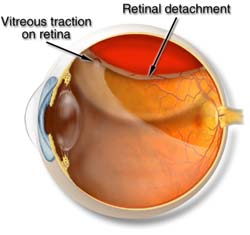
Detached Retina - The retina is a thin film that lines the inside of our eyes and is reposible for receiving images before they are sent to the brain. Compression of the eyeball causes the retina to lose shape and detach. Retinal detachments do not cause any pain.


Cataract - Trauma can cause changes to the lens inside the eye. It becomes clouded and makes vision blurry. Very dense cataracts can cause the pupil to look white rather than the usual black.


Glaucoma - Damage to the nerve (Optic nerve) that sends signals from the retina to the brain. The drainage system inside the eye can be damaged (Angle recession glaucoma) due to impact or blocked by blood building up inside the eye (hyphema, see image below). This causes pressure inside the eye to increase and compress the optic nerve.

Corneal abrasion - The cornea is a clear dome at the front of the eye. It is very fragile and can be easily scratched or scraped. Very painful and can leave a permanent scar.

Orbital bone fracture - The eye socket is formed by mutiple little bones. Breaking any one of these can result in different complications including sinus leakage, trapped eye muscles, and nerve damage.

All the conditions mentioned above can lead to partial or complete, temporary or permanent loss of vision in the affected eye.

A Few Other Notable Eye Injuries in Recent Years

Mattias Ohlund (1999)-
Injury: Hyphema, cataract, glaucoma
Treatment: Multiple surgeries, has a small tube permanently implanted to allow fluid to drain from his eye
Missed: 2 months


Bryan Berard (2000)-
Injury: Detached retina and cataract, legally blind in right eye
Treatment: 7 surgeries
Missed: One and a half seasons


Steve Yzerman (2004)-
Injury: Broken orbital bone and scratched cornea
Treatment: Surgery
Missed: 2004 playoffs and 2004 World Cup


Mats Sundin (2005) -
Injury: Broken orbital bone
Missed: 1 month


Can you guess what all of these players (including Manny) had in common? Drum roll, please...
Answer: None of them were wearing a visor on their helmet.

So why, in a sport that is based around a 3-inch disk of solid rubber flying through the air at 100 mph and careening in different directions within the blink of an eye, doesn't the NHL make it mandatory to have some sort of eye protection?

Bryan Berard said AFTER returning from his injury "We're pro athletes, and the choice should be ours."

I guess thats why...

For the rest of us NON-professional athelets, please try to use protective eyewear whenever possible!!
--

Recent Popular Posts:
Snoop Doc and Dr. Dre, OD
How Trevor Linden Sold Out: The Prequel
How Trevor Linden Sold Out: An Eye Doctor's Perspective

Wednesday, December 15, 2010

Flashing Lights: It's A Camera... It's Lightning... No, It's Your Retina!

It's not uncommon for patients to come in to the clinic and mention they have recently seen something that looked like a streak of lightning or a flash bulb going off in some part of their vision.


How does this happen?The retina is a thin film that covers the inside of our eyes. It is the part of the eye responsible for receiving light signals and sending them to the brain. As you can expect, it needs to be very sensitive.

Due to this high sensitivity, any small movement of the retina can cause signals to be fired back to the brain, making us think that eye is sensing light.


3 most common situations in which flashes are noticed:
1)
Patients with near-sighted prescriptions. Near-sightedness is mostly due to the eye ball being larger than average. As the eye grows, the retina becomes stretched. This can lead to areas of thinning and tension.

2) The vitreous gel inside the eye is attached to the retina in multiple areas. Movement of the vitreous can pull on the retina leading to the sensation of flashes.

3)
Pressing on the eye. Mechanically releases the chemicals (Phosphenes) that start the signal to the brain.


FAQ:
Q:
Are flashes a sign of something bad?
A: Potentially. Flashes could be the first signs of the retina is being pulled, torn, or detached.

If you notice flashes in your vision, especially if combined with new floaters, it is very important to see your eye doctor right away to make sure there are no signs of any tears or detachments.
Q: Do people who have had laser eye surgery still need to worry about their retinas?
A: YES YES YES!!! It is vital for patient's who have had any kind of surgery to have regular eye exams.


Thanks for reading. Please feel free to send me questions and comments about this or any other topic.


Sunday, December 12, 2010

Why Josh Koscheck Lost: An Eye Doctor's Perspective

Of course, I'm here to discuss reasons other than Georges St. Pierre's obvious superiority as an MMA fighter. After all, this eye doctor is unbiased and simply here to impart knowledge related to eyes and eye health.

So, why did  Josh Koscheck lose?

It all started early in the first round of the UFC 124 championship bout on Saturday evening. GSP began landing his lightning quick, left-handed jabs to the right side of Koscheck's face. By the end of the first round, his right eye was almost completely swollen shut.

Now, fighting with one eye closed presents multiple challenges. The first, and most obvious, is that Koscheck was not able to see attacks coming from his right side very well anymore. But what I believe to be a more difficult problem to adjust to is the loss of depth perception one encounters when both eyes are not open.

We need both eyes open and working together to perceive depth. Its the main concept behind 3-D movies. Koscheck was basically trying to fight GSP in 2 dimensions. That must have made it nearly impossible for him to judge not only the punches coming towards him but also the punches he was trying to throw (especially if that is his dominant eye).

Doctors confirmed that Koscheck suffered a broken orbital bone, which is serious injury that can result in damage to the muscles and nerves surrounding the eyeball. Also of concern in this case would be the potential for retinal detachments which could lead to blindness if not dealt with immediately.

Josh Koshcheck, it's time to see your eye doctor.

See also Mirko Cro Cop's Eye Injury before his previous fight with Frank Mir.

Wednesday, October 6, 2010

Diabetes and the Eye

Don't forget to check out my Twitter and Facebook pages.


Diabetes is a disease that has grown and spread exponentially in the last 20 years, reaching epidemic proportions. Yet, many people do not know how devastating it can be and the effects it can have on the eye.

Background:

There are 2 main types of diabetes:
  • Type 1 (Insulin dependent):
    • Early onset (usually by teenage years)
    • Autoimmune disease - the body attacks itself and causes destruction of the cells that make insulin
      • Insulin is the chemical which promotes uptake of sugars from the blood into muscle and other tissues
    • Treated with insulin replacement
    • Can lead to death if not treated
  • Type 2 (Non-insulin dependent):
    • Later onset (usually over the age of 40)
    • Body tissues develop resistance to insulin
    • Very commonly associated with sedentary lifestyle, high fat diets, and obesity (No surprise its huge in North America!)
    • Treatment:
      • Early/mild: weight loss, diet changes, and exercise
      • Moderate: All of the above plus oral meds that encourage glucose uptake
      • Severe: All of the above plus insulin
    • Significantly increases risk of heart attack, stroke, and kidney failure
The end result for both, if not well controlled, is high sugar (glucose) levels in the blood stream.

Normal blood sugar levels:
  • Healthy patients should have glucose levels of approx 4 mM
  • Diabetic patients are instructed to try to maintain them below 6 mM
    • Uncontrolled diabetics often have glucose levels of 15-20 mM (if not higher)

The Eye:
While high sugar levels in the blood can affect the structure and function of cells and chemicals, the main concern in the eye is loss of integrity of the blood vessel walls.

The tiny retinal blood vessels can become leaky, thus allowing fluid, blood, and proteins to seep into the retina. If left uncontrolled, this can result in any combination of the following:
  • Diabetic retinopathy:
    • bleeding in the back of the eye, including leakage into the vitreous gel thus causing loss of vision
    • lack of blood and oxygen delivery to areas of the retina
      • death of retinal tissue - permanent loss of vision
      • development of new, weaker blood vessels (neovascularization) which can cause further leaking and fibrosis of the retina
  • Macular edema
    • swelling of the macula (central part of retina) causing decrease of vision
  • Retinal detachment:
    • Fluid leakage behind the retina or fibrosis due to new blood vessels causing it to be pulled away
  • Neovascular glaucoma:
    • Due to the lack of oxygen delivery, new blood vessels begin to grow at the front of the eye and block the drainage of fluid causing increased pressure in the eye which can result in damage to the optic nerve - yet another way to cause vision loss
If the diabetes is adequately treated, some of the milder problems can be reversed and vision may be restored.

If you have diabetes, or know someone who does, it is very important to keep in mind the effect it can have on your eyes. Regular, annual eye exams are imperative and are no less than the standard of care of diabetic patients.

If there are any questions please feel free to ask. And as usual, please forward this information on to anyone who may find it useful.

Thanks for reading.


Tuesday, August 10, 2010

Eye Floaters!

What are floaters?
- There is a gel that takes up most of the space inside the eye called the Vitreous
- The little dots or squiggly lines we see when looking at something bright (ex. a white wall) are areas of the vitreous that are slightly thicker thus casting shadows on the retina
- Mostly these are nothing to worry about

When are floaters significant?
- Floaters can be a sign of Vitreous Detachment or, more significantly, Retinal Detachment
- If you ever notice lots of new small floaters or a new large floater, this is something to be concerned about

 Click here to watch a funny video from The Family Guy about Floaters. Forward to the 35 sec mark.